
It's no coincidence that I got to see you again

Updated: Aug 4
The lounge was packed before either artist touched a microphone. Hotel W's Live Sessions — the weekly Thursday series powered by Symphonic Latino — had pulled a crowd so thick that, by the time things got going, you couldn't have slipped a needle through the room.
When I arrived, the night was still assembling itself in pieces. Mari Angarita was finishing the visuals for the screen behind the stage. Her special guest for the night, Rodri Zorro, was filming a clip for his own socials. The rest of the band were in that loose, pre-show mode — playing a few bars, chatting, doing absolutely nothing in particular. And on the screen behind the bar, Canada was beating Qatar 5–0, a score that would eventually close out at 6–0. Considering the hotel sits right next to the Canadian embassy, the room had its own quiet chaos going before the music even started.
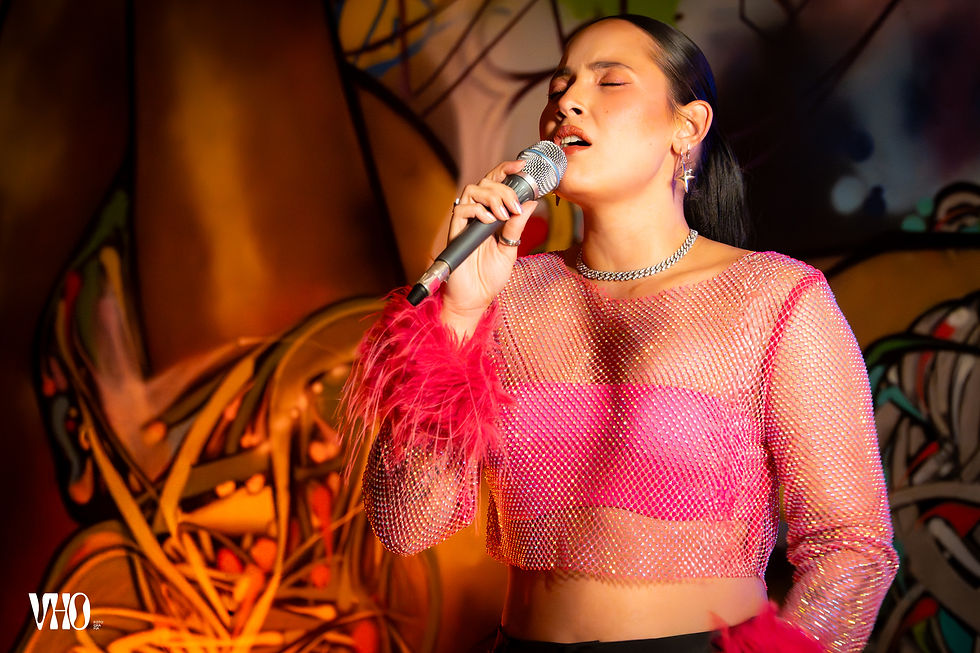
SAMU opened at around 8 p.m., and from the first note it was clear this was someone who'd done the work. Her set was all originals — including her most recent single, "Mírame" — plus one song written in English, a nod to the pop influences that clearly shape her sound. Her vocal technique was immaculate, controlled in a way that let her take risks without ever sounding shaky, and her stage presence matched it: easy, confident, fully in command of the room. The high point came during "Ley de Gravedad," when the paisa singer taught the audience the chorus and, by the second pass, the room was singing it back to her like they'd known the song for years. The visuals and the musicians behind her were just as sharp, giving the whole set a polish that felt bigger than a Thursday night in a hotel lounge.
By the time Mari Angarita took the stage around 9 p.m., the night had shifted into something more intimate. This was her first show performing songs from her debut EP "Lo que quiero recordar", backed by her band — Selena on guitar, Manuela on percussion, and Jessi on bass. After a collaboration with Rodri, a quick costume hiccup threw a wrench into the transition. Mari laughed it off without missing a beat:
Did you think Tini was the only one who changed outfits?"
But the real story of the night was in who was watching. Mari is from Yopal, the capital of Casanare, out in Colombia's eastern plains — llanero country, roughly nine hours from Bogotá by road, a world away from the city she's called home since her university years. Her parents had never been able to make the trip to see her play in Bogotá before. Watching them finally be in the room for it clearly got to her: her voice caught mid-performance during "Cielo," one of three moments — alongside "A mi lado" and the set-closing "Ancla" — where the audience knew the words well enough to carry them back to her, filling in the lines as her own voice wavered.
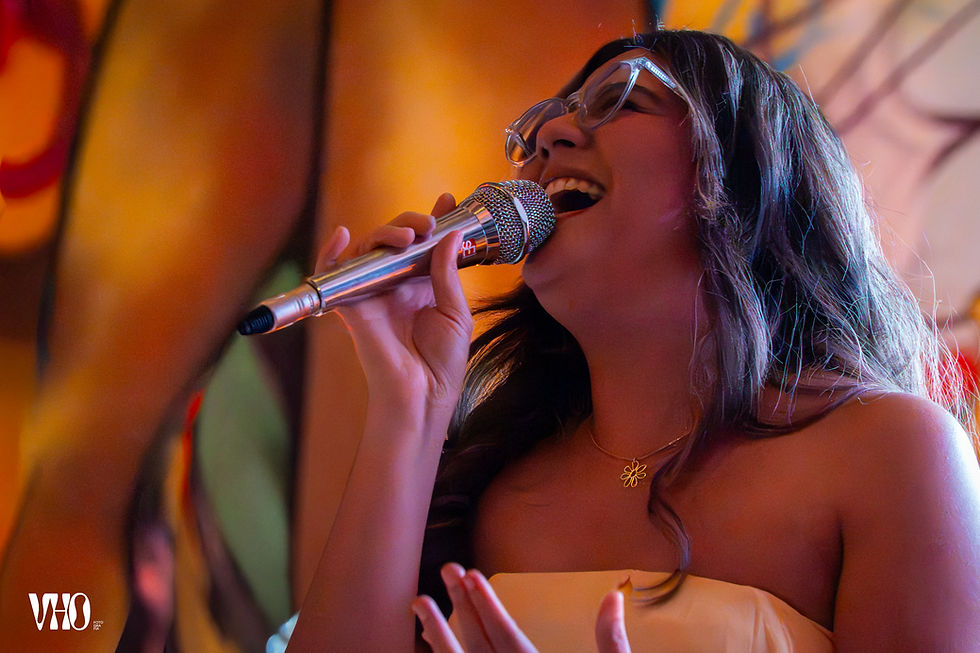
Between songs, she told a story from childhood: her first time singing on a school stage, wearing a uniform that had gotten too small for her without anyone noticing until she was already up there. Her parents, she said, nearly died of embarrassment when she arrived home that day. It's the kind of memory that sounds like a throwaway anecdote until you realize it's the exact moment she decided music was what she wanted to do.
I should say upfront that this isn't an unbiased account. This is the third or fourth time I've photographed Mari, and every time she asks me to be there for another step in her career, it means a lot to me. We met in college, studying music together — I ended up changing both my major and my school, but we never lost touch, and watching her build this from the front row, camera in hand, has been one of the genuine privileges of doing this work.
The crowd reflected that closeness. The room was full of people who actually knew the songs — friends, family, and, unexpectedly, a handful of hotel executives who'd wandered over from the World Cup broadcast and just stayed. There were tears, there was singing along, there were the kind of fan screams usually reserved for arena tours, aimed just as much at the band as at Mari herself.
By the end of the night, the Canada game was long forgotten. The W's Thursday series doesn't get nearly enough credit for what it pulls off — two artists, two completely different audiences, one room that somehow held both. It's also not the first time these sessions have hosted someone who'd go on to bigger stages: they hosted Sugey Torres, the spanish voice of Encanto's Luisa Madrigal; and Emyl Rusev, now riding a viral wave straight into opening for Ed Sheeran in Bogotá last May. If that pattern holds, this might just be the night people point back to when Samu and Mari Angarita's careers started to turn.
About the artists

Sara Monsalve Urrea, known as SAMU, is a singer-songwriter from Medellín whose sound draws openly from Justin Bieber, Conan Gray, and Dua Lipa — pop built on melody and restraint rather than spectacle. She released her debut EP, "Sin Título," back on June 21, 2024, and has kept building steadily since: a spot on Caracol's revived musical competition "A Otro Nivel" earlier this year (she didn't make it past the judges' live round, but the national TV exposure was real), a performance at 2025's MedaYoung Fest under Medellín's youth-talent initiative Medellín Music Lab, her first radio appearance on Medellín's Radio Fantástica in May 2025, and a recent appearance alongside the Medellín Philharmonic. Her latest single, "Mírame," dropped June 10, 2026 — two years almost to the day after her first EP, and a clear marker of how far her voice has come since.
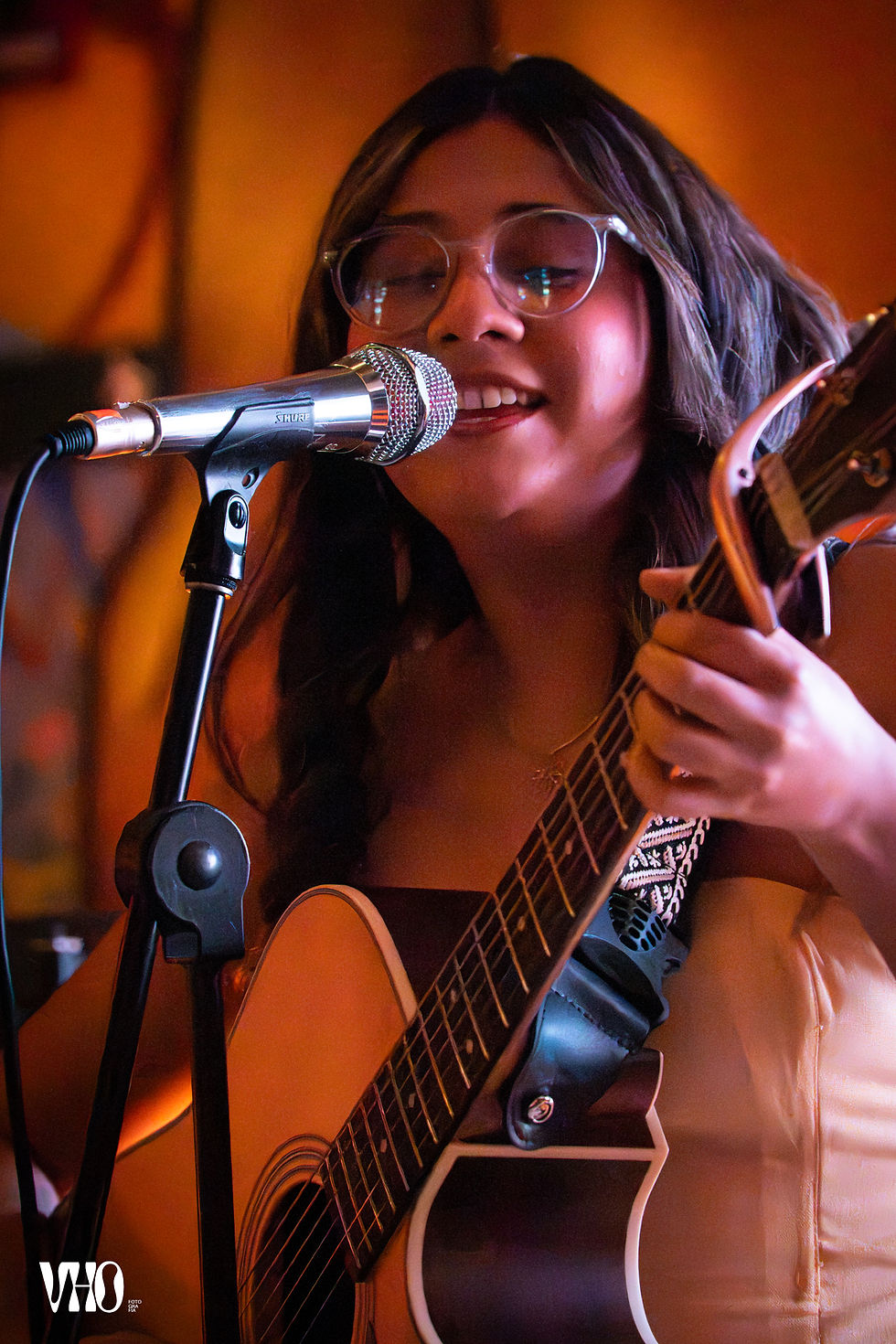
Mariana Angarita Sánchez, known simply as Mari Angarita, is a singer-songwriter originally from Yopal, now based in Bogotá, where she majored in music with an emphasis in vocal performance. Her sound leans into soft, calm pop ballads with a Latin-Colombian undercurrent — gentle, unhurried, closer to a hymn than a hook. Her debut single, "Ancla," came out May 30, 2024, with the rest of her catalogue arriving in sporadic singles before her debut EP landed on August 15, 2025. Mari is also openly Christian, and several of her songs are written as quiet offerings to God without ever naming Him directly, which gives even her most personal lyrics a second, unspoken layer.
With around 2,400 monthly listeners on Spotify, Mari has created a fanbase that seeks "music to heal, embrace and accompany good times and not-so-good times," as the singer explains. She was the opener for Colombian duo Maca & Gero, has sung in renowned venues like the Teatro Astor Plaza and the 440 Music Hall in Bogotá, and has been recognized by her alma mater for her artistic growth.


Comments