
"P*ssing incels off" electronica: Eva Pagán's new genre for EP2


November 20th feels like the perfect day to create a new music genre specifically for women, by women, and about being women. Eva Pagán’s second EP is a six-song argument for the independent life, and it ends with a love song to the people who listen. She describes herself as an electropop Spanglish musician, and the shortest way to explain her is as a multicultural, very gay party: upbeat pop in the vein of Empress Of and Shygirl, vulnerable lyrics inherited from her acoustic days as Eva Westphal, and samples of her German dad and her Puerto Rican grandfather tucked into the outros. EP2 is built around one idea: the two sides of independence in your mid-twenties.
We talked on a Sunday, two days before her New York show, a year after our last conversation about “’Til I Die”. Between a quick call from her dad in German and an interruption from her dog Lulu, we went through the EP track by track, the all-female team behind it, the law school life, and the day she hopes to land in Colombia.
Behind all the confidence, and the sexy, and the fun, and the love songs, is just a little girl who is so grateful that you’re listening to this EP at all.
Eva joined the call still recovering from gastritis, and she explained how she got it with a straight face. Spicy wonton soup on a Saturday. A week of feeling terrible. A call to her parents, because her dad is a doctor. “What’s the point of you having gone to medical school if you can’t tell me what’s wrong with me?” she asked him, laughing. At urgent care, the doctor ruled out appendicitis. “Girl, I could have told you that,” she says. The next day she made herself spicy plantain chips. She thought she was fighting a food-borne illness, so she kept eating the one thing that was making it worse. “It’s all my own fault,” she says, and she’s right.
Two sides of the same coin
Gastritis aside, Eva built EP2 like a short story, with a beginning and an end that don’t move. In between, the order is flexible.
What’s the inspo behind the EP? What’s the story?
I think the central thesis is the two sides of the coin. That’s the opening track, “24/7,” and the last track, “Dreams.” Both are about being a girl in my mid-twenties with lots of dreams, enjoying my independence, figuring myself out and feeling a lot of gratitude for the adventure that is an independent life. That thread goes through all of the songs.
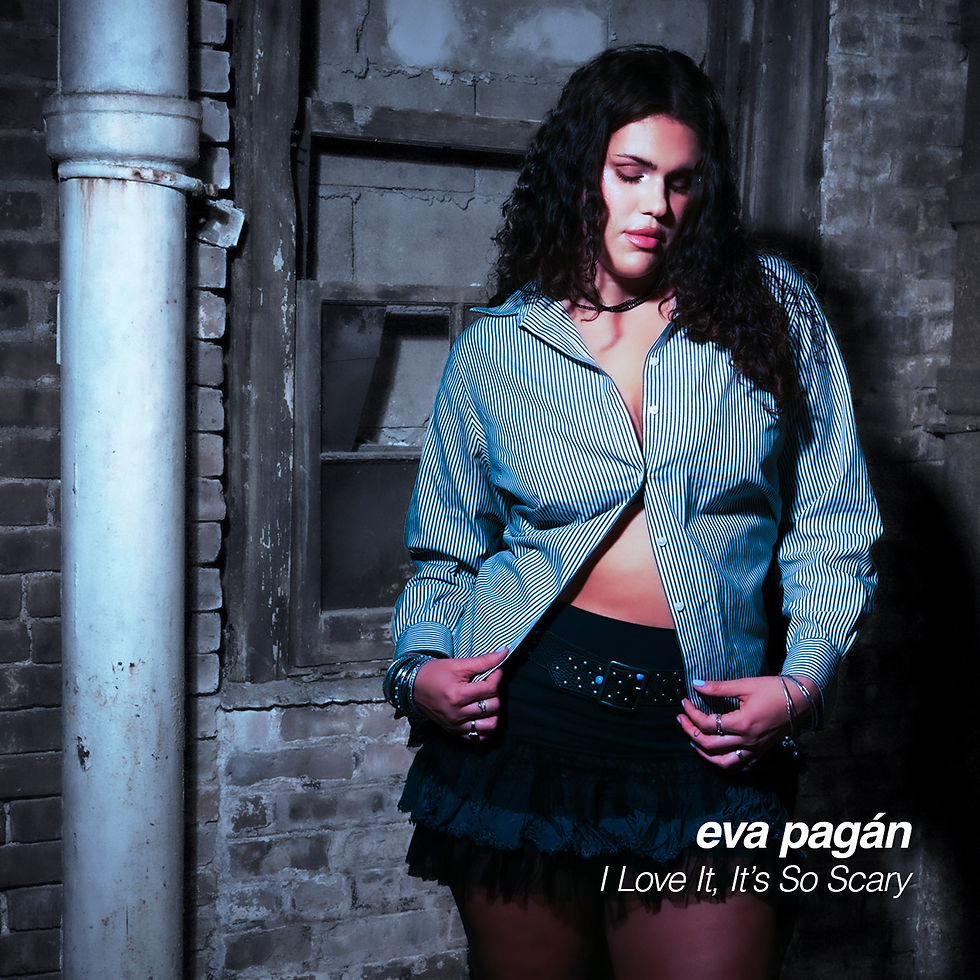
Then “I Love It, It’s So Scary” is the most literal one. If you’re two songs in and wondering what the central message is, that’s it. “Gold” is the sexier, fun side: being single in your mid-twenties and what that looks like. “Qué Dulce” is a love song for an ex-situationship, who I’m friends with, so she loves it. “Cinema” sounds like a hookup song but it’s really a non-hookup song: I could be with anybody, but I don’t want anything unless it feels like the movies. And “Dreams” is the most stripped-back song on the EP. It’s a love song to the people who listen to my music.
So the order is intentional. You’re not meant to listen on shuffle?
You can listen on shuffle. The only thing I’m married to is starting with “24/7” and ending with “Dreams.” You can mix up the middle, but the opening and the closing are very married to each other.
Is LA EP2?
“24/7” and “Cinema” are very New York. “Dreams” and “I Love It, It’s So Scary,” the flight between New York and LA. New York will always be number one for me, but LA is lovely. The color is the bright pink of the bougainvillea that grows over every wall and highway, the sunshine every single day, and food I never tried on the East Coast: Mexican, Salvadoran, Guatemalan. What does it smell like? Contrary to how New York smells like sh*t, LA is just... nothing. Miami smells like rain.
Each song is one stage of the same overachiever. “24/7” is about locking in: mentally, always thinking about the next step, how to manage the relationships that make it happen, how to deliver to a growing team. “Gold” is about standards, and “Cinema” is the flip side, knowing what you want and refusing to settle. “Qué Dulce” is the vulnerable one, and “Dreams” is the little girl guiding the whole thing.
Twenty-five and done with marriage
The song that hit me hardest was “I Love It, It’s So Scary.” I just turned 25, so I heard my own life in it. I also noticed a line connecting it to “I’ve Never Written a Song About a Boy” (2020): in 2020, Eva was rejecting straight marriage. In 2026, she’s rejecting marriage altogether.
Was that evolution intentional?
No, you just brought that up and I just realized it. I like it. If I were in an English class I’d say, “the evolution of an author.” I was 19 when I wrote that, and it was about a big life realization. “I Love It, It’s So Scary” was born out of another one: turning 25 and realizing that when I was 20, being 30 felt really far away, and now it’s five years away. Do I want my life to look drastically different at 30? The idea fills me with dread when it’s about the traditional milestones. But the idea of being 32, making songs in an apartment in Brooklyn and taking my dog for a walk? That’s thrilling.
What was the can of worms you opened with this EP?
The idea that I might not want the same things that society tells women they should want, and realizing that’s okay, that I can trust my gut. And how amazing it is that I can reflect on that and choose something else, because there are so many women who can’t, who would give anything to trade places with me. The miracle of that.
Do the two EPs connect?
Definitely. In EP1 the biggest thing was my excitement about this new sound that felt so true to me, like a kid with candy. EP2 is, let me decide how much candy each song gets. It’s a little more emotional and vulnerable. People who miss my Eva Westphal days will find songs they love on this one, especially in “I Love It, It’s So Scary,” “Gold” and “Dreams.”
When your listeners finish the EP on release day, what main feeling do you want them to hold on to?
I want them to feel empowered to think about what they want for themselves and how to make that happen, regardless of societal expectations.
The change also reached the stage. For EP1 she was running most of it herself. For EP2 she has a DJ, Jasper, “a hot gay guy with pink hair” who dances behind her and DJs while she sings.
I just think it’s so fun to see a lesbian and a gay guy killing it on stage.”
“Dreams” is her favorite song to rehearse: Jasper keeps telling her it’s perfect, and she keeps asking to run it again. Her New York show happened two days after we spoke. Los Angeles follows on December 12.
Last time we talked, you said no tour yet because you "didn't have enough songs". With a decent catalogue now, when are you coming to Colombia?
I want to learn the paisa accent first. Once I’ve mastered it, I can bring Abuelita, because she’s Colombian. But I’ve got to get famous first. If you get the country of Colombia together to say “we will buy tickets,” I’d do it for 200 tickets. A guaranteed show of 200 people, I’m there.
Eva’s first full title in Spanish, "Qué Dulce", if we ignore her Chiquitita cover alongside her mom, is a love song for an ex-situationship from Argentina. The hardest part to decide what to call it was her audience, which is mainly non-hispanic.
How did you choose the title?
I was trying to figure it out, because I’m saying much more in the song. But not all of my audience speaks Spanish, and “Qué dulce” they’ll kind of get, versus “Hablarte,” where an English speaker would go, “what is hablarte?” At the end of the day I think it’s the best way to encapsulate it: how sweet. It doesn’t need to be forever (wink wink) to be super sweet. And it wasn’t like, “let me write a chorus in Spanish.” It came out of me in Spanish, which is nice.
I'm such a woman
In July, Eva became a voting member of both the Recording Academy and the Latin Recording Academy, part of each one’s 2026 New Member Class. She announced it on Instagram with a line that explains why it mattered: she didn’t grow up around the music world, and every year she watched the GRAMMYs wondering who the artists meant when they thanked “the academy.” Then she found out that voting members were the artists, producers and songwriters she admired. Now she is one of them. That’s the public side. The daily one looks different, and it starts with who is in the room when the songs get made.
Eva writes with a small circle. Sabrina Song co-writes and produces “24/7,” “I Love It, It’s So Scary,” “Cinema,” and “Dreams,” and Emma Botti joins the writing on all of those except “Cinema.” “Gold” is Eva alone, as writer and producer. “Qué Dulce” belongs to Amanda Joy, who co-writes and produces it. Samantha Henry mixes and Gabi Grella masters every track but that one, which Girl Annual mixes and masters.
People don’t mention mix and master engineers, and I want to change that. They’ve been with me since EP1 and they deserve it.
How did a 100% female studio shape the energy and the message?
I’m such a woman. Having my songs and experiences filtered and made completely by women is so important to me, because none of the songs are about men. I don’t have straight guys in my life. I just don’t see the point of including them in the truest part of my self-expression if they’re not present elsewhere either. It’s almost become my norm, but I know it’s not the norm. I’ll see a production breakdown on Instagram, go “this girl’s so good,” look at the page, and it’s a John.
"Oh my god, John, what are you doing with a computer? I forget that men can produce,” she says, laughing.
Even the visuals follow that logic, with one exception. Her creative director, Tom Casimir, is, in her words, as much of Eva Pagán as she is: “a gay guy and a lesbian coming together to have this creative baby.” He also is responsible for the heels in the “I Love It, It’s So Scary” video.
Those gigantic heels. Respect.
I couldn’t walk in those. I had to step out of them into flats, because the set was an LA dirt road. If you notice the full-body shots in the heels, I’m not walking back and forth. I’m standing, doing arm stuff. In most of the other shots I wasn’t even wearing them. EP3 is going to give heel classes.
The heels and the styling are the whimsical end of her work. Not everything she makes goes on an EP, and not every song has to be fun. Recently she posted a short song on TikTok about the Cornell 7 case, the alleged gang rape at the Chi Phi fraternity house, where seven men are accused.
A lawyer in the case has said 57 members were in the fraternity’s group chat. Fifty of them said nothing.
My whole life is macro and micro feminisms.
Pagán, Westphal and the Name on the Diploma
I've called Eva a law student by day and an electropop artist at night, and she delivers in both halves. She loves law school, and she says it’s the first kind of learning that doesn’t feel like learning for its own sake. It explains how the world she lives in is run. She is doing an externship in immigration law in Los Angeles right now.
My dream life is full-time music plus five to ten pro bono hours a week of immigration work. And being legally literate as a musician, reading my own contracts, is a bonus.
Do you think your musical project is related to why you’re doing immigration, or is it more unrelated?
I think it’s related. It’s all an expression of my independence, of different parts of myself. I would have been a musician in any lifetime, I’m sure of that. I probably wouldn’t have gone to law school in every lifetime, because that’s a product of my environment. My parents are academic people, and that path was going to be accessible to me, which is obviously very privileged. So law school is an expression of my environment, and music is an expression of my nature. Neither one is more true than the other. But music is always going to be the truest love of my life.
How has stepping fully into Eva Pagán felt, and what does it mean for your family’s legacy?
I love it. I didn’t realize this before, because my legal name and my artist name used to be the same. But now when I say my full name, it’s almost always as the musician. In law school you just say “I’m Eva.” So I’ll introduce myself as Eva Pagán and then think, wait, I’m Eva Westphal… I forgot.
How does your dad feel about this?
He makes fun of me. He says, “Don’t forget you’re German.” I’m like, “Girl, I’m six feet tall. How could I forget?” The name on my diploma is going to be Eva Westphal, and that’s my legal name, I’m not changing it. But on Spotify, in press, on everything, it’s Pagán. I love that. I went from 100% an expression of my dad to representing both my mom and my dad. It’s a shared spotlight.
Dad, you can handle it.
She has found one more person who shares the name. An engineer from Spain, also called Eva Pagán, has a Wikipedia page, and Eva has already felt bad about showing up in her search results. “Queen,” she says. “I can’t wait to have a Wikipedia page too.”
The aesthetic and her name aren’t the only things she’s working on. For her birthday in August she posted a list on Instagram titled “Goals for year 27”: keep working on her sleep schedule, make music she’s proud of, hang out with more creatives and musicians, go on more hikes, become proficient at Ableton Live, and keep her nails painted light blue. The biggest dream, which she labels a pipe dream, is to chart at #98 on the Billboard Bubbling Under chart and celebrate with tooth gems. It can slide to year 28, she writes, as she is not too concerned about timing.
What would 5-year-old Eva think of you, and what would you say to Eva ten years from now?
Five-year-old Eva would probably think I’m cool, which is fun. She loved the Barney song in Spanish. She made her mom film her singing it over and over, then went to look at the videos. I was such a little attention whore. She’d ask me to film her, and I’d tell her she did great. And to Eva in ten years, I’d say thank you for locking the f*** in. I have a strong belief that it’s going to work out. I’d say:
Congrats on the Grammy, girl.

About the Artist
Eva Pagán is a queer, Puerto Rican-German musician known for her signature Spanglish electropop sound and vulnerable lyrics. Formerly performing as Eva Westphal, she reclaimed her mother's maiden name as part of a larger reintroduction rooted in her heritage. Her debut EP under her new name, “EP1” arrived in November 2025 as a love letter to her immigrant family, earning comparisons to Empress Of, early Christina Aguilera, and Charli XCX. Her music is written, produced, mixed, and mastered by an all-women team. Her sophomore EP, EP2, arrived on November 20th.


Comments