
The voice born on the riverbank returns to the water

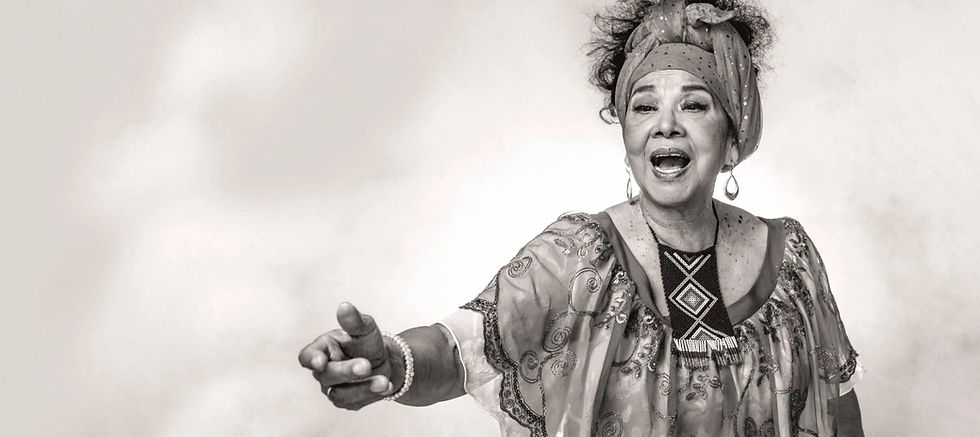
The world of music mourns the loss of one of its most radiant stars. Totó La Momposina, the beloved Colombian singer who carried the soul of the Caribbean coast in her voice, passed away at the age of 85, as confirmed by her family on her socials. Her death marks the end of an era, but her legacy shines brighter than ever. Known for her powerful voice and deep commitment to preserving Colombia’s rich folk traditions, Totó was more than a singer—she was a cultural guardian and a bridge between generations.
On Sunday, May 17th, in Celaya, Mexico, far from the Magdalena River that shaped her, Totó died surrounded by her daughter Angélica and her grandchildren. Sonia Bazanta Vides, the woman the world knew as Totó La Momposina, passed from a myocardial infarction after complications with aphasia and a devastating deterioration to her health. The flame she spent her entire life keeping alive — a flame of drums, of memory, of a people's identity — has left the hands that held it. And yet it does not go out.
Colombia is in mourning today. So is much of the world.
She belonged to the river
To understand Totó, you have to understand the geography that made her. She was born on August 1st, 1940, in Talaigua, a small village in Colombia, nestled on an island in the heart of the great Magdalena River — one that stretches over a thousand miles from the Andes all the way to the Caribbean Sea. The surrounding region is known as the Depresión Momposina, the floodplain of Mompox, and it was from this place that Sonia took her stage name: La Momposina.
She came from a five-generation family of musicians. Her father was a percussionist; her mother, Libia, a singer and dancer. Before she could fully articulate what music meant, she already lived inside it — the drums, the call-and-response, the storytelling that wasn't written down anywhere because it didn't need to be. Unfortunately, when Totó was still small, the period known in Colombia as La Violencia — a brutal civil conflict between Liberal and Conservative factions that left hundreds of thousands dead — forced her family to flee their home. The Bazanta Vides family, with their Liberal political affiliation, became targets. As Totó herself would later recount, she walked as a little girl through streets where the dead had been left, learning to dodge, hide, and survive. She had been uprooted from the river, from the place that sang in her blood — and perhaps that early exile is precisely what made her hold on to that music with such ferocity for the rest of her life. She carried Mompox with her everywhere she went.
THe inheritance
For international readers unfamiliar with the traditions Totó dedicated her life to: the music of Colombia's Caribbean coast is one of the most layered, historically rich sonic traditions on the planet. We may be biased, as our founder and some collaborators are Colombians themselves, but we honestly believe that to be true. It is the direct product of five centuries of collision and survival — Indigenous peoples, enslaved Africans, and Spanish colonizers, each bringing their own instruments, rhythms, and spiritual practices, all of them fusing together in the heat and humidity of the coast.
Totó played and championed many of these forms. Cumbia — today one of Latin America's most widespread rhythms, recognizable in everything from Mexican norteño to Argentine folklore — was born on the Colombian coast as a courtship dance between African and Indigenous communities. Bullerengue is an older, more sacred form, driven almost entirely by drums and women's voices, historically sung by Afro-Colombian women in ceremony. Mapalé is fierce, percussive, physical — a dance rhythm that carries the pulse of African heritage directly. Porro is brass-led and festive, rooted in the Sinú and San Jorge river valleys. Gaita refers to music built around Indigenous flutes made from cactus — pre-Columbian instruments that survived the conquest.
Totó chose to play all of those, nothing about her music was accidental. Every rhythm was a document. She proudly explained that flutes are pre-Columbian, the drums are from Africa, the guitar from the conquistadors. And she'd add — with the kind of historical precision that belied her easy warmth — that even the Spanish guitar had its roots in Moorish Africa.
Some of her most important work include:
The Fisherman: A drum-heavy anthem that honors the humble life of coastal fishermen, driving home the deep visual connection between Colombia's river cultures and the African-inspired chalupa rhythm.
My name is Cumbia: Considered a secondary national anthem in Colombia, this track personifies the cumbia genre itself, telling the story of how Indigenous flutes and African drums fused in the Caribbean.
Purslane: Named after a resilient river weed, this hypnotic, call-and-response bullerengue track showcases Totó’s raw, earth-shaking vocal power over a minimalist bed of ancestral hand drums.
The Bright Well: A festive, dawn-til-dusk chalupa track from her celebrated album Pacantó, celebrating bohemian resilience, community joy, and the irresistible urge to dance until the morning light.
Light the Candle: A timeless, hypnotic masterclass in traditional mapalé and cumbia rhythms that captures the literal and spiritual energy of dancing by candlelight in the open plazas of the Caribbean coast.
An infectious, high-energy chalupa track that blends driving Afro-Colombian hand drums with quick-witted, call-and-response vocal phrasing, making it an enduring favorite for global dancefloors and modern electronic remixes.
Goodbye Fulana: A deeply moving, melancholic farewell anthem composed by Lucho Bermúdez, where Totó’s emotive delivery over a skeletal rhythm arrangement perfectly captures the bittersweet essence of Afro-Colombian bullerengue.
“You have to dedicate yourself to what you have inside: to what you heard, to what you saw…”.
The Education of a Custodian

Totó understood early that loving something isn't enough to preserve it. She pursued formal training at the conservatory of the National University of Colombia in Bogotá, studied music history, choreography, and rhythm at the Sorbonne in Paris — where she lived for several years — and also studied at institutions in Santiago de Cuba and Havana. She didn't choose between the academy and the oral tradition; she insisted on both.
And then she went looking. Alongside researcher and filmmaker Gloria Triana, she traveled along the Magdalena River, village by village, seeking out cantadoras — traditional female singers, the custodians of these rhythms — and learning directly from them. Not just the notes, but the meaning, context, and memory behind each song.
"I am not the star"
By the 1970s, Totó was touring internationally — Latin America, Western and Eastern Europe, the United States. But the moment that perhaps best encapsulates her stature in the cultural history of her country came in 1982, when she accompanied Gabriel García Márquez to Stockholm, Sweden, to perform at the ceremony where he received the Nobel Prize in Literature.
Think about that image: Colombia's two most towering cultural figures of the twentieth century, together in one room, one accepting the world's highest literary honor, the other filling the hall with the drums and songs of their shared homeland. García Márquez built Macondo from the memory of the Magdalena and the coast; Totó's music was the sound that Macondo would have played at its own wake. Both of them were translators — turning the particular into the universal, the local into something the whole world could feel.
And yet, across an entire career of Nobel ceremonies and world stages and international acclaim, Totó actively resisted becoming the center of the story. Her son Marco Vinicio recalled in the days after her death the phrase she returned to throughout her life: "I am not the star. The star is Colombian music." It was not performative humility. It was a conviction that shaped everything — the way she introduced her shows, the way she spoke about the rhythms, the way she insisted on naming the drummers, the cantadoras, the specific villages each song came from. She understood that being the vessel, and not the destination, was the most honest and most powerful way to do what she did. In a world that rewards the artist's ego over the material they interpret, Totó chose deliberately otherwise. Every time she walked onto a stage in Stockholm, in Paris, in Tokyo, she wasn't exporting Sonia Bazanta Vides. She was exporting the Magdalena.
Don't let the flame die down
In 1991, Totó performed at the WOMAD Festival — the World of Music, Arts and Dance, the global music festival founded by Peter Gabriel. It was her first invitation, and it led directly to her participation in Real World Records' famous Recording Week, where musicians from around the world gathered at Gabriel's studios in England to record and collaborate. Working with legendary American producer Phil Ramone — who had records with Paul Simon, Bob Dylan, and Frank Sinatra — Totó and her group recorded the sessions that would become La Candela Viva, her debut album released in 1993.
Critics and listeners who had never heard cumbia or bullerengue before found themselves unable to look away. Real World Records, which had already released artists like Nusrat Fateh Ali Khan and Youssou N'Dour, recognized in Totó something rare: a performer whose passion was inseparable from her scholarship, whose joy was inseparable from her grief. The album ignited a global following that would accompany her for the rest of her career.
The accolades came steadily after that — Grammy nominations, Golden Congos at the Barranquilla Carnival, the Latin Grammy Special Award for Musical Excellence in 2013, the Lifetime Achievement Award at WOMEX in 2006, the Colombian Ministry of Culture's Lifetime Achievement Award in 2011. She performed in Japan, Canada, Finland, Switzerland, England, Spain. She brought her tambores to stages that had never heard them.
But she never stopped also performing for her people. The woman who opened for García Márquez at the Nobel was the same woman who showed up to community festivals, who ran workshops, who taught younger musicians not just technique but responsibility — the responsibility of knowing what you carry and refusing to let it disappear.
Her son Marco Vinicio, reflecting on her legacy, put it with a clarity that stopped us in our tracks: when she was on a stage, he said, it wasn't her up there as an artist — it was Colombia itself, present in that space. And Totó herself had a phrase she returned to again and again, one that her son shared in the days after her death: "I am not the star. The star is Colombian music."
She meant it. That was never false modesty — it was a philosophy she lived by, a discipline that shaped every performance, every interview, every lesson she gave. She stepped aside so the music could be seen.
Her final performance was at the Festival Cordillera in Bogotá in 2022. She retired at 82, her health beginning to fail, including aphasia — a condition affecting speech and language. She spent her final years in México, quietly, away from cameras. She was not famous for being Totó La Momposina anymore. She was just Sonia, with her daughter and her grandchildren, surrounded by the love she had always played toward.
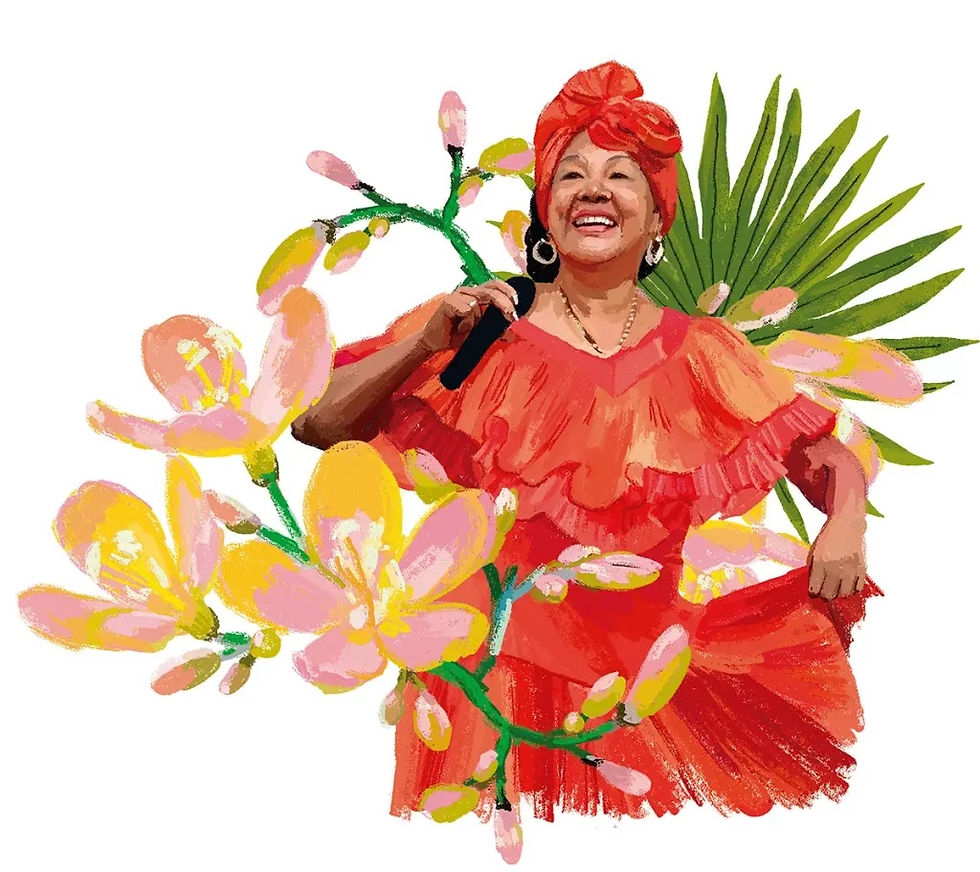
The governor of Bolívar, Yamil Arana, spoke for the department she carried in her name when he said she had traveled the world with Bolívar not just in her stage name, but in her heart. He announced that a sculpture in her honor will be installed on the Calle de la Frescura in Mompox — the town her name was always a tribute to. "I would have liked to unveil it with her," he said.
The Ministry of Culture posted this morning: "Today we say goodbye to the eternal Totó." Eternal is the best word, but there's no perfect one to describe her legacy. The traditions she spent her life documenting, performing, and defending did not die with her because she made sure of it. She gave them to her children and grandchildren, both biological and artistic. She gave them to every young musician who sat and watched her work, who felt something in the drums that they couldn't name but knew they needed.
She once said that folklore is something dead, in a museum — but traditional music, music from the old days, is alive. And anyone who plays those rhythms today, anywhere in the world — in a Bogotá living room, at a Paris music hall, at a festival in Tokyo — carries something Totó passed forward.
The living flame has left one set of hands. But it keeps burning.
A ceremony will be held in Bogotá on May 27th to celebrate her life and work.
Glorious, powerful, eternal Totó. Rest easy. Thank you for everything you gave us.
Frontlight Magazine sends its deepest condolences to her family, her colleagues, and everyone who loved her music.


Comments